
Support us from £3/month
We deal with almost 1000 cases a year assisting communities, groups and individuals in protecting their local spaces and paths in all parts of England and Wales. Can you help us by joining as a member?
We are delighted that land in Hertfordshire has been registered as common, giving it protection, and the public rights of access there. The land failed to be registered as common land when the registers were first opened under the Commons Registration Act 1965 (the 1965 Act) for a three-year period.
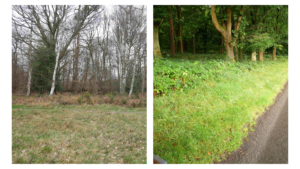
Frithsden Beeches and the land abutting Frithsden Lane, both now registered as common land. Photos: Open Spaces Society
Hertfordshire County Council has granted two of the society’s applications for land just north of Berkhamsted, an area famously associated with nineteenth-century struggles to preserve common land.
One registration comprises woodland known as Frithsden Beeches, along with three small parcels of land within the existing Northchurch and Berkhamsted Common, comprising in all about 23 hectares.
In 1981 Northchurch and Berkhamsted Common became finally registered under the 1965 Act as common land—except for Frithsden Beeches and the three small parcels of land mentioned above. The omitted land was excluded because of an agreement made at the time between the interested parties, but it is not known why.
The second registration is a wide strip of grass abutting Frithsden Lane, comprising just under four hectares and which was formerly part of Frithsden Common.
In 1968, Berkhamsted Residents’ Association made an application to register land at Frithsden Copse which included the roadside strip. The land at Frithsden Copse was provisionally registered as part of Berkhamsted Common. Following an objection, the land at Frithsden Copse was withdrawn and while other land at Berkhamsted Common became finally registered, the land at Frithsden Copse was excluded. At the time it was believed that the excluded land was not common land.
However, part 1 of the Commons Act 2006 reopened the opportunity to rescue lost commons which were excluded by the 1965 Act for various reasons. The applications made by the society demonstrated that the land remains manorial waste, which means that it can now be registered as common land.
Says Frances Kerner, our commons re-registration officer: ‘We are very pleased that Frithsden Beeches and the three parcels of land have been reunited with Northchurch and Berkhamsted Common, and that the wide strip of land which was anciently part of Frithsden Common is now registered as common land. All the land will be protected long into the future.
‘Moreover, because the land is owned by the National Trust, it now will become specially-protected common land under the National Trust Acts, to be kept “unenclosed and unbuilt on as open spaces for the recreation and enjoyment of the public”.’