
Support us from £3/month
We deal with almost 1000 cases a year assisting communities, groups and individuals in protecting their local spaces and paths in all parts of England and Wales. Can you help us by joining as a member?
Yesterday, 11 August 2026, was the 150th anniversary of the Commons Act 1876, the Act which spelt the death knell for the parliamentary inclosure of common land in England and Wales.
Our society, then the Commons Preservation Society, played a part in its enactment. Our president, Lord Eversley, with vice-presidents James Bryce MP, Charles Dilke MP, Henry Fawcett MP, and other supporters, won amendments to strengthen the Bill against inclosures, and in the interest of agricultural labourers.
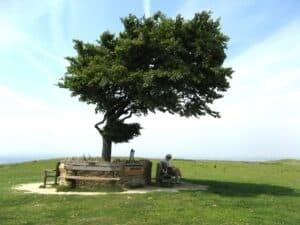
Cleeve Hill, Gloucestershire, which is regulated under the 1876 Act. Photo: Open Spaces Society
There were three main elements to the Commons Act 1876 which were to the public’s benefit.
- It was the first Act on a national basis to enable the regulation of common land in the public interest. The Act enabled commons to be managed and regulated by the appointment of conservators. A proposal had to show benefit to the neighbourhood, and it gave local people rights of recreation. The conservators could make bylaws to control public behaviour.
- The Act slowed the inclosures of common land to a trickle, which eventually ceased in the early twentieth century. Future proposals for inclosure of common land had to show the same benefit to the neighbourhood as those for regulation, and this proved (as was intended) increasingly challenging.
- The Act (section 29) made it a public nuisance to encroach on or inclose a town or village green—legislation which endures to this day and which can be used to ensure that greens are protected.
Says Kate Ashbrook, our general secretary: ‘The Commons Act 1876 made a significant difference to commons, which are places of immense public value but which had been relentlessly attacked by the inclosure movement. This Act was an important step on the way to recognising that commons matter to us all, and subsequent legislation has developed this further. For instance, the Countryside and Rights of Way Act 2000 gave the public the right to walk on all commons, so the confinement of access to local people on commons regulated by the 1876 Act no longer applied.
‘We are grateful to our predecessors for fighting for this Bill in Parliament and ensuring that the Commons Act 1876 was a milestone for our commons.’
A list of regulated commons is available here. The last inclosure, at Elmstone Hardwicke near Cheltenham, was approved in 1914.