
Support us from £3/month
We deal with almost 1000 cases a year assisting communities, groups and individuals in protecting their local spaces and paths in all parts of England and Wales. Can you help us by joining as a member?
We have helped to save the attractive 463-metre footpath, south of Wimbish Green, six kilometres south-east of Saffron Walden, in Uttlesford District, Essex.
The path, known as Wimbish footpath 70, runs through the grounds of three residential properties. The owner of one of them, Midfield, applied to close the route under section 118 of the Highways Act 1980 on the grounds that it was not needed for public use. This was supported by Essex County Council (ECC), who made an order to close the path.
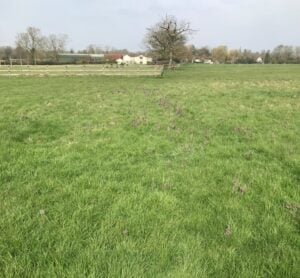
The view north-east from Wimbish footpath 70. Photo: Open Spaces Society
The Open Spaces Society and Wimbish Parish Council objected and so the matter was referred to the Planning Inspectorate. Inspector James Blackwell LLB held a public inquiry on 21 April, and decided, on behalf of the Secretary of State for Environment, Food and Rural Affairs, not to confirm the order. (See ROW/3360619 Decision date: 20 May 2026).
The legal test for making an order to close a path under section 118 is that it is not needed for public use. The path runs in a north-east – south-westerly direction. From the north-east it crosses common land and then passes through woodland, with a ditch crossing, and across a grazing field. The landowner claimed that it had been little used for the past 50 years, being overgrown with a missing footbridge. Two nearby byways provided an alternative route. ECC supported these arguments.
Our local correspondent for Essex, Katherine Evans, appeared at the inquiry. She made the case that one of the byways was rutted and regularly used by vehicular traffic, which made it unpleasant for walkers, and that the footpath provided a circular route. Katherine, with a local Wimbish Parish Councillor, submitted evidence of complaints about the state of the footpath and of usage.
The inspector noted that the footpath ‘provides an attractive and pleasant walk through the countryside’. It is distant from the houses themselves and from the immediate garden areas around each of the homes.
The Inspector did not confirm the footpath closure as he considered that, if it were reinstated, the ‘levels of use would be comparable to the usage of other recreational footpaths in the area’. He noted that Wimbish ‘is a small rural community where levels of use would not be expected to be high’. Any privacy and security benefits to the landowners from the closure would be ‘relatively minor’. He concluded that the order did not satisfy the legislative tests and refused to confirm it.
Says Katherine: ‘I am delighted that the inspector’s decision has highlighted that the Department for Environment, Food and Rural Affairs’ Presumptions Guidance says that path diversions or replacements should be the first port-of-call and not closures. Many farmhouses and rural cottages are on footpath routes as people used to walk to work, the chapel, the pub, and other destinations. In a world of gated dwellings these paths are in danger.’
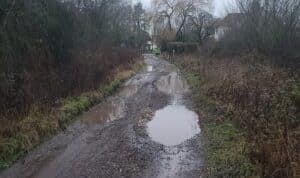
Byway 98, not a suitable alternative. Photo: Open Spaces Society
Adds Helen Clayton, our case officer for rights of way: ‘We are pleased that the inspector recognised the utility and recreational value of Wimbish Footpath 70 as a necessary and integral part of the rights-of-way network in the area. We are delighted that Katherine fought to oppose its closure on our behalf, saving the footpath for public use and enjoyment.
‘The society is fortunate to have local correspondents across England and Wales who act for us in defence of paths and open spaces. We now look forward to the council returning the footpath to public use by removing the obstructions and replacing the missing footbridge.’