
Support us from £3/month
We deal with almost 1000 cases a year assisting communities, groups and individuals in protecting their local spaces and paths in all parts of England and Wales. Can you help us by joining as a member?
We are celebrating the quashing of an inspector’s two decisions to refuse to register new commons in Hayle, Cornwall.
On 30 December 2020, two applications were made to register common land, one by Tomas Hill in relation to 99 hectares of tidal land at Hayle Estuary, and another in relation to 54 hectares of land at Hayle Towans with Tomas Hill acting for the applicant. The applications were made under the Commons Act 2006, which enables the registration of waste land of a manor, where the land unsuccessfully was registered under the Commons Registration Act 1965 and remains open, uncultivated, and unoccupied at the time of the new application[1] .
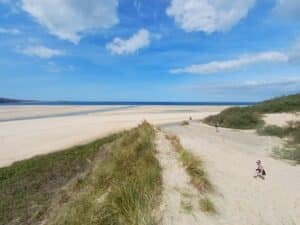
Hayle Estuary and a bit of Hayle Towans, the land which the society considers should be registered as common. Photo: Tomas Hill
Both applications had to show, among other things, that the original applications to register under the 1965 Act were withdrawn or cancelled at the request of the original applicant. In two decisions of inspector D M Young,[2] the inspector found that they were not. But a High Court order has confirmed that the inspector was wrong, and both decisions have been quashed. The applications will now go before an inspector for redetermination.
Speaking today, Hugh Craddock, a case officer for the society, said that: ‘We are delighted that we have been able to assist Tomas in getting these decisions quashed for redetermination. In both cases it was plain as a pikestaff that the original applicants under the 1965 Act had agreed to the cancellation of the provisional registrations made by them.
‘That laid the way open under the 2006 Act to fresh applications to register the land as common land. But in both cases the inspector misunderstood how the 1965 Act worked, and failed to see that it was inevitable that, on the evidence before him, the original applicants had asked for or agreed to cancellation.’
Hugh added: ‘The decisions in these two cases, if followed in the future, could have been prejudicial to the society’s own applications in Cornwall and elsewhere. We therefore could not let the decisions stand, and brought a challenge against the Secretary of State for Environment, Food and Rural Affairs. We are very pleased that the Secretary of State and interested parties saw sense, and agreed to a quashing order.’
Tomas Hill, one of the two applicants, adds: ‘I should not have been placed in the position of having to commence a judicial review on a point of law I have successfully argued on many previous occasions, and I am extremely thankful for the society’s intervention. This is an excellent example of why people should support the Open Spaces Society. Like the society, I will continue to fight to protect Cornwall’s commons for future generations.’
[1] Under paragraph 4 of Schedule 2 to the Commons Act 2006. Paragraph 4 has been brought into force only in nine local authority areas in England (including Cornwall), and in the whole of Wales, but the deadline for applications in Cornwall was 31 December 2020 and it no longer is possible to make such applications in Cornwall.The society continues to make applications in relation to North Yorkshire and Cumbria, and plans to make applications in Wales in the future.The society also has 17 outstanding applications yet to be determined in relation to Cornwall.
[2] JP BSc (Hons) MA MRTPI MIHE. The inspector is appointed by the Secretary of State for Environment, Food and Rural Affairs. The decisions are dated 10 November 2025 and may be found at: www.gov.uk/guidance/common-land-notices-and-decisions-published-in-2023-2024-and-2025#section-1, as COM/3363391 Hayle Towans; and COM/3363395 River Hayle Estuary and Beaches.