
Support us from £3/month
We deal with almost 1000 cases a year assisting communities, groups and individuals in protecting their local spaces and paths in all parts of England and Wales. Can you help us by joining as a member?
We have welcomed the decision of an inspector acting for the Welsh Ministers to refuse commons consent for an extension of the Gryphonn quarry at Trefil common, four kilometres north-west of Tredegar in Blaenau Gwent county, just outside the Bannau Brycheiniog National Park boundary.
In a decision dated 23 September 2026 (ref CAS-04928-F9C0T6), inspector I Stevens BA (Hons) MCD MBA MRTPI states that the proposed extension of the quarry, taking in over 22 hectares of the common, is ‘not in conformity’ with the Welsh Government’s guidance on works on common land. The inspector finds that the extension would interfere with commoners’ grazing rights,
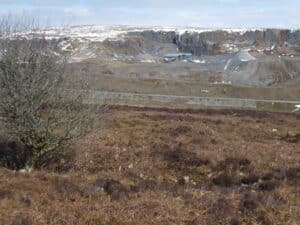
Photo of Trefil quarry from Trefil Ddu to the west. The quarrying was planned to open up behind the building to the left, on the face behind the waste-filled scree, heading backwards but mainly to the left. © Copyright Alan Bowring and licensed for reuse under this Creative Commons Licence.
public access, and nature conservation, including a harmful effect on the designated site of special scientific interest (SSSI)1. The inspector notes that the applicant, Gryphonn Quarries Ltd, did not explain why it had not examined the alternative of an exchange of common land—commended in the Welsh Government’s guidance in such circumstances—and says such an approach should be considered.
Hugh Craddock, our case officer for common land, said: ‘We are delighted that the application has been refused, but it ought never to have been made in this form in the first place. The applicant, Gryphonn Quarries Ltd and its advisers, blundered in with an ill-prepared and ill-researched application. It assumed that, having received planning permission for the extension, commons consent was no more than a formality. It did not explain why it had not considered the alternative of an exchange of common land. It denied that the land was used for commoners’ grazing, and made no proposals for compensating the commoners for long-term deprivation of their grazing rights. And it ignored the serious impact of the extension on the SSSI, presumably because the planning authority had granted permission notwithstanding.’
Hugh added: ‘This is a classic exposition of how not to seek consent for works on common land. It is rare to see such an arrogant proposal, and satisfying to see it rejected. Regrettably, even though the national park authority for Bannau Brycheiniog had objected to the planning application because of impact on the adjacent National Park, it did not object to the commons application. Natural Resources Wales, on the other hand, reiterated its objection, and has been rewarded with this refusal. We hope that the national park authority will be swifter to engage in commons applications in future.’
- The decision letter states (para.19) that: ‘Most of the application site is in the Mynyddoedd Llangynidr a Llangatwg, Cefn yr Ystrad a Chomin Merthyr Site of Special Scientific Interest’.