
Support us from £3/month
We deal with almost 1000 cases a year assisting communities, groups and individuals in protecting their local spaces and paths in all parts of England and Wales. Can you help us by joining as a member?
We have compelled the Planning Inspectorate to adopt new internal guidelines on the maps used for common-land applications.
In October 2024 Moreton C Cullimore (Gravels) Ltd, represented by Burges Salmon LLP, applied to the Planning Inspectorate under section 16 of the Commons Act 2006 to deregister and replace a hectare of Lower Cow Pasture, part of Shuthonger Common north of Tewkesbury in Gloucestershire, to facilitate a haul road for transporting gravel across the common.
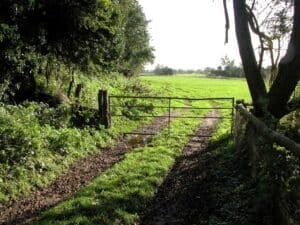
Photo: gateway leading to the release land on Lower Cow Pasture common. © Copyright Philip Halling and licensed for reuse under this Creative Commons Licence.
The society pointed out that the application plan, purporting to identify the release and replacement land, was drawn on the Ordnance Survey’s Explorer map, published at a scale of 1:25,000 (about two and a half inches to one mile), albeit photographically enlarged, whereas regulations require the use of ‘an Ordnance Map, at a scale of not less than 1:2,500’ (about twenty-five inches to one mile).
The society’s representations about the non-compliant plan went ignored by the Planning Inspectorate, while Burges Salmon insisted that the plan met regulatory requirements. The inspector’s decision, granting the application, was issued on 16 October 2025, and attached a supposedly replacement map: this still was drawn on an Explorer map, but purportedly required to be printed at A0 scale.
We challenged the inspector’s decision through the pre-action protocol. The Government Legal Department (acting for the Planning Inspectorate) declined to accept that the decision was unlawful, but said that ‘steps have been taken to ensure that applications under section 16 of the Commons Act 2006 are compliant with regulation 5(2)(a). …Instructions have been issued to relevant…Planning Inspectorate’s case officers and Inspectors to that effect. The Planning Inspectorate is also taking steps to amend its internal procedures relating to such applications to ensure compliance in future.’ The society now has seen amended internal instructions which stress the importance of ensuring that application maps are compliant with the regulations.
Hugh Craddock, one of our case officers, welcomed the new internal instructions on map scales. But he said: ‘It is astonishing that the combined forces of the Defra casework team in the Planning Inspectorate, the inspector, and a high-powered firm of solicitors specialising in planning, could not between them recognise that a map drawn at a scale of 1:25,000 is not the same as a map drawn at a scale of 1:2,500, and no amount of photographic enlargement will resolve the defect.’
He added: ‘it is clear from the legislation and case law that, where there is a requirement to use an Ordnance Survey map at a particular scale, that is exactly what must be done. If this application had gone unchallenged, applicants might just as well have torn a page showing the United Kingdom out of a world atlas, and blown that up to 1:2,500. The requirement for a large-scale map is there for a reason: it is so that the local authority holding the commons register map can show the release and replacement land at a sufficient scale to ensure accuracy and legibility. The applicants in this case ignored that requirement.
‘We hope that, thanks to our intervention, new internal guidance will avoid a repetition,’ says Hugh.
The society is grateful to counsel Philip Petchey of Francis Taylor Building, and Matthew McFeeley of Richard Buxton Solicitors for their advice in this case.