
Support us from £3/month
We deal with almost 1000 cases a year assisting communities, groups and individuals in protecting their local spaces and paths in all parts of England and Wales. Can you help us by joining as a member?
We are delighted that a damaging amendment to the Planning and Infrastructure Bill, proposed by Lord Banner and others, was dropped. The amendment aimed to remove long-standing public rights on green spaces when the land is sold by a local authority. It was debated in the House of Lords on Monday night (3 November) but not then moved.
We had urged peers to oppose it and are highly relieved that the amendment was not pushed to a vote.
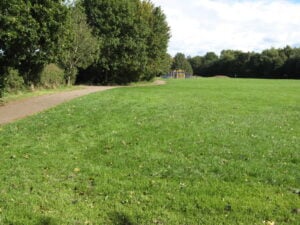
Greenfields recreation ground, Shrewsbury. Photo: Open Spaces Society
The amendment would have made it much easier for local authorities to sell open spaces to developers, ignoring and negating public rights[1] . It would have reversed the supreme court’s judgment in the Day case[2] which saved part of Greenfields Recreation Ground in Shrewsbury from development.
Opposing the amendment, Baroness Young of Old Scone said: ‘This amendment has caused substantial concern that it erodes the protection of green space and removes long-standing public rights of green spaces, where the land is sold by local authority, with or without consultation.’ She countered Lord Banner’s assertion that judicial review was a solution for the aggrieved public, saying that this ‘misrepresents the position of many local communities, which are absolutely incapable of bringing a judicial review, either by degree of organisation or financially.’
Baroness Bennett of Manor Castle added: ‘… “the new enclosure”, from the late 1970s to 2019, has seen 10% of what was public land in Britain transferred into private hands. That is two million hectares of land. This would be yet more loss of public good for private profit …’.
Peers from all the main parties spoke in opposition.
Baroness Taylor of Stevenage, the Lords Minister for Housing and Local Government, responded: ‘Open and green spaces, including public parks, are an essential part of local social infrastructure. They are the lifeblood of local communities. When people are asked what they value about their local area, parks and green spaces are consistently cited as a priority, particularly for those living in urban areas.’
She said that the government was ‘announcing a wider review of existing protections, so that communities, local authorities and developers can have clarity about when and how land is protected. We will aim to bring coherence to the legal framework, making protections more transparent and accessible, so that communities can protect their most valued open spaces.’
She criticised Lord Banner’s amendment ‘which could have unintended consequences’. It would not provide robust safeguards to prevent local authorities being incentivised to sell land without following the statutory consultation process. She said that ‘the duty to consult before disposing of land subject to a statutory trust remains an important safeguard as it gives local communities an opportunity to speak up in favour of preserving their most important local spaces.’
In the light of this, Lord Banner did not move his amendment.
Says Kate Ashbrook, general secretary of the Open Spaces Society: ‘This is a significant result. We believe that, if the amendment had been passed, many open spaces with rights of recreation could have been lost without local people knowing that their rights were even at risk.
‘We look forward to discussing how the law can be clarified while ensuring that the protection of green spaces is not weakened in any way. We are deeply grateful to all the peers who spoke against this deeply damaging amendment.’
You can listen to our general secretary’s live interview on BBC Radio Oxford, on 4 November, here (1hour, 50 minutes).
[1]When a local authority disposes of open space it must advertise its intention and allow for public objection. It must then consider the objections before deciding whether to proceed with the disposal (Local Government Act 1972, section 123(2A)). The amendment would have meant that land subject to a statutory trust (the Public Health Act 1875 section 164 and the Open Spaces Act 1906) for public recreation would have been freed from that trust if the authority failed to comply with the section 123 procedure—even if the non-compliance was negligent or intentional. It could then have been developed.
[2]R (on the application of Day) v Shropshire Council [2023] AC 955.