
Support us from £3/month
We deal with almost 1000 cases a year assisting communities, groups and individuals in protecting their local spaces and paths in all parts of England and Wales. Can you help us by joining as a member?
The Open Spaces Society supports the confirmation of the Glyndŵr National Park in north-east Wales, and we were delighted when Natural Resources Wales made the designation order on 12 January 2026. This followed a formal consultation, in which 67 per cent of those responding supported the proposal, and only 31 per cent opposed it.
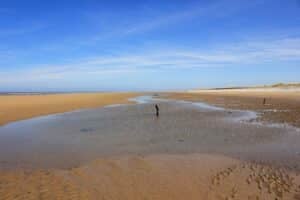
Barkby Beach, within the proposed boundary of the National Park. Photo: Jeff Buck
Because local authorities objected there had to be a public inquiry, and this was announced by Huw Irranca Davies, then Deputy First Minister and Cabinet Secretary for Climate Change and Rural Affairs, on 26 March 2026, two days before the Senedd rose for the election.
Unfortunately, Plaid Cymru, which has a majority in the new Senedd, does not believe in the national park and has decided to abandon the public inquiry and the confirmation order. However, it allowed a four-week period, which ended on 11 November, for the submission of further evidence. We are not hopeful that the response will cause it to change its mind. This is what we have said.
Open Spaces Society’s submission regarding the confirmation of the Glyndŵr National Park
The Open Spaces Society is Britain’s oldest national conservation body, founded in 1865. We campaign for commons, greens, open spaces and public paths throughout Wales and England. We are one of the organisations which lobbied for the National Parks and Access to the Countryside Act 1949 and have taken a keen interest in protected landscapes in Wales and England.
We are deeply dismayed that the Welsh Government is minded not to proceed with the Glyndŵr National Park, and are grateful for the opportunity to make further representations.
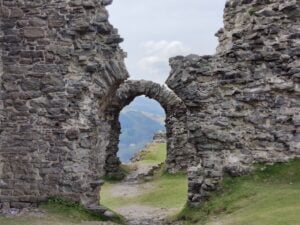
Castell Dinas Bran, which would also sit within the National Park boundary. Photo: Mat Fascione
The area meets the criteria for designation, which is why Natural Resources Wales, the government’s statutory adviser on such matters, has decided to designate. The next step should be a public inquiry, where all the issues can be debated and tested in public. It would be a severe injustice if we were to be denied that opportunity by Welsh Government pre-emptively closing the door on the national park.
The landscape is splendid and varied, the biodiversity is rich and could be richer, the opportunities for public recreation and enjoyment are significant, and the cultural heritage is unique. The area would benefit from designation by being better protected, and its special qualities enhanced and treasured; the local economy would benefit from visitors; farmers would benefit from increased scope for funding to improve conservation, marketing and access, new funding opportunities would be available for local businesses, and the national park could be a testbed for initiatives which would ensure not only that it was truly Welsh, but also that others could learn from it.
Fifty years ago the Cambrian Mountains went down in history as a national park which was lost at the last minute. Please do not let the Glyndŵr National Park go the same way.
We urge Welsh Government to continue with the confirmation process by holding a public inquiry before it takes a decision about confirmation.