
Our commons re-registration officer, Dr Frances Kerner, is researching lost commons which are eligible for registration as common land under part 1 of the Commons Act 2006. Frances explains the work that needs to be done before an application can be made to the commons registration authority.
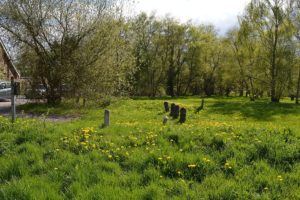
Batchworth Heath. Photo: Wikipedia
Re-registration of common land comprises three strands of research. First, the circumstances of a common’s provisional registration under the Commons Registration Act 1965 must be checked. This is to determine whether the refusal to confirm the provisional registration meets the criteria as set out in paragraph 4 of Schedule 2 to the Commons Act 2006..
Having established that the common is eligible for re-registration, the site is viewed using Google maps and other online web sites that allow a preliminary assessment of the character of land today.
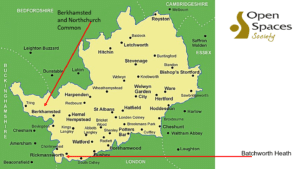
Project location for common land research. Photo: Open Spaces Society
The second part of the research is to check in person whether the land actually has the physical character of waste land. Either myself or someone else visits the site to check that the land meets the criteria. Photographs and notes are taken to record the site visit. The land must be ‘open, uncultivated and unoccupied’. These words all have specific meanings but essentially the land must not be enclosed by fences/walls, it must not show evidence of cultivation or be occupied to the exclusion of others. In practice, determining whether the character of the land meets these criteria is not always as straightforward as it might seem and sometimes necessitates discussion with colleagues.
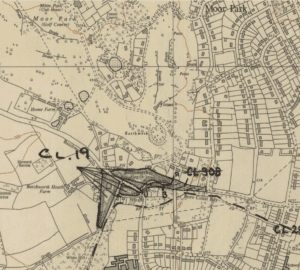
Copy of register map for Batchworth Heath. Photo: Natural England
The third and final part of my work is to undertake historical research to determine whether the land is of manorial origin. With a growing number of historical sources on-line it is possible to undertake some of this research at a desk. Eventually however, there will be a need to attend places where manorial documents are held (some are held privately or in other repositories). The National Archives (TNA), The British Library (BL) and the record office serving a county are usually where most manorial records are held. Where manorial documents survive, they provide the best evidence in support of an application. Where they don’t, other sources must be searched. Copies of relevant documents are made because these are submitted as evidence when the application is made.
Since 2020. I have been supporting applications made up until the end of that year in Cornwall, Devon, Hertfordshire and Kent and making new applications in North Yorkshire. The deadline for applications in North Yorkshire and Cumbria is March 2027 and in Wales is May 2032.
If you found Frances’ report interesting here are some or our popular common land resources.